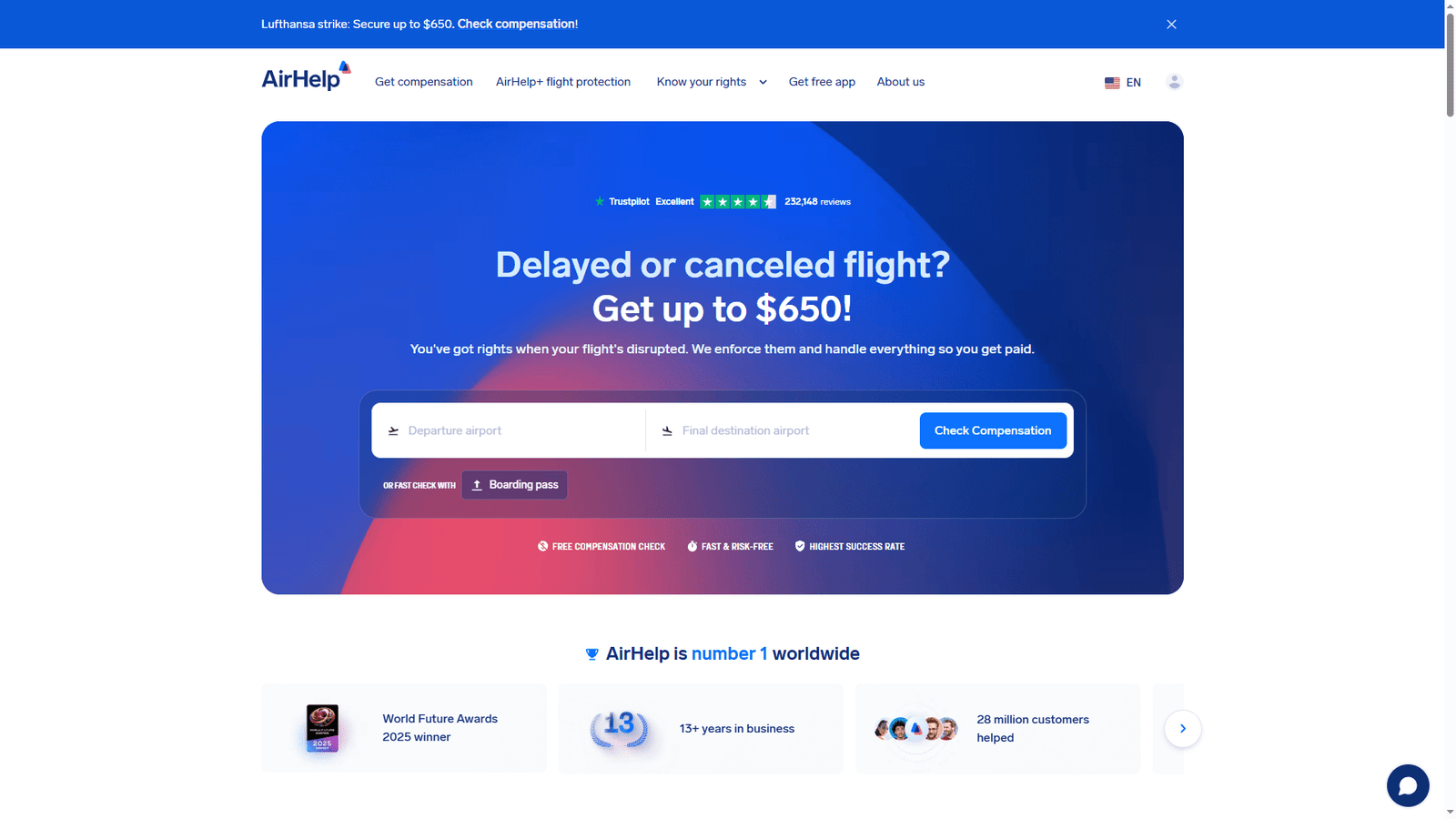
Disclaimer: This post contains affiliate links. If you choose to use AirHelp’s services through the links provided below, I (Mai Nguyen) will receive a commission at no extra cost to you. This support helps keep maing.space running and allows me to continue sharing travel tips and tech reviews.

Introduction
We have all been there. You are sitting at the airport gate, excited for your trip or exhausted and just wanting to get home, when the dreaded announcement comes over the PA system: “Flight [Number] has been delayed.” Or worse, canceled entirely.
It is frustrating, stressful, and can ruin your entire itinerary. But did you know that for many of these disruptions, the airline might legally owe you money? Not just a food voucher or a generic apology, but actual cash compensation—up to €600 ($650) per person.
The problem? Airlines don’t make it easy to claim. They bury you in paperwork, cite obscure legal clauses, or simply ignore your emails.
This is where AirHelp comes in.
AirHelp claims to be the world’s largest air passenger rights organization, helping travelers get the compensation they deserve. But is it worth giving them a cut of your money? Today on maing.space, I am reviewing AirHelp to see if they are the best ally for the stranded traveler.
What is AirHelp?
AirHelp (accessible at airhelp.com) is a technology company founded in 2013 with a specific mission: to enforce air passenger rights. Headquartered in Berlin, Germany, the company operates globally and supports travelers in over 30 languages.
Their core business revolves around EC 261, a European law that requires airlines to compensate passengers for long delays, cancellations, and denied boarding. However, they also handle claims under other regulations, including the Montreal Convention and Brazilian laws.
To date, AirHelp states they have helped over 16 million passengers. They combine legal expertise with technology to automate the claim process, essentially fighting the airline’s lawyers so you don’t have to.
How Does It Work?
The beauty of AirHelp lies in its simplicity. They have turned a complex legal process into a few clicks.
- Check Eligibility: You enter your flight details (airline, flight number, date) on their website or app. Their scanner instantly tells you if you are owed money.
- Submit Documents: You upload your boarding pass and sign a digital power of attorney allowing them to represent you.
- They Fight: AirHelp contacts the airline. If the airline refuses to pay, AirHelp’s legal team will take them to court.
- Get Paid: If they win, they send the money directly to your bank account (minus their service fee). If they lose, you pay nothing.
Key Features & Services
AirHelp offers two main ways to use their service.
1. Standard Service (No Win, No Fee)
This is for the traveler who just had a bad flight and wants to file a one-off claim.
- Risk-Free: You do not pay anything upfront.
- The Cost: If AirHelp wins your case, they deduct a Service Fee (usually 35%) from your compensation. If legal action is required (going to court), they take an additional Legal Action Fee (usually 15%), totaling around 50%.
- Best For: Occasional travelers who don’t want to pay a monthly subscription.
2. AirHelp Plus (Membership)
This is a subscription service (yearly fee) designed for frequent flyers. It acts like “compensation insurance.”
- Essential Plan: Includes checking all your past flights and full support for future claims without the 35-50% deduction. You get 100% of the compensation.
- Complete Plan: Includes everything in Essential, plus lounge access during delays and immediate payouts (extra cash sent instantly if your flight is disrupted, regardless of the airline’s eventual payout).
- Best For: Business travelers or anyone flying 3+ times a year. The cost of the membership is often lower than the fee you’d pay on a single successful claim.
Pros and Cons
Is it worth sharing your compensation with a middleman?
Pros:
- Hassle-Free: This is the biggest selling point. You fill out a form in 3 minutes, and they do months of work for you.
- No Win, No Fee: For standard claims, there is zero financial risk. If they don’t get you money, you don’t pay a dime.
- Legal Muscle: Airlines often ignore individual passengers but respond to AirHelp because they know the company will actually go to court.
- Global Knowledge: They know the laws in Europe, the US, Brazil, and internationally, navigating complex jurisdiction issues you might miss.
Cons:
- High Fees: Taking 35% to 50% of your payout is a significant chunk. If you are comfortable reading legal texts and writing formal letters, you could do this yourself for free.
- Wait Times: Legal processes are slow. While AirHelp acts fast, airlines can stall. It might take months to see the money (though this is the airline’s fault, not necessarily AirHelp’s).
- Not Every Flight Qualifies: Weather issues or “extraordinary circumstances” (like strikes or air traffic control restrictions) usually exempt airlines from paying, which can be disappointing if you get your hopes up.
Who Should Use AirHelp?
- The Busy Professional: If your time is worth more than the effort of fighting an airline for 6 months, AirHelp is a no-brainer.
- The Nervous Traveler: If legal jargon and confrontation intimidate you, AirHelp provides peace of mind.
- The Frequent Flyer: The AirHelp Plus membership is genuinely good value. Keeping 100% of your claim on just one disrupted flight pays for the subscription for years.
Conclusion
AirHelp is not a charity; they are a business, and their fees reflect that. However, they provide a vital service in an industry known for treating customers poorly. They level the playing field between individual passengers and massive airline corporations.
If you have experienced a flight delay in the last 3 years, I highly recommend entering your flight details into their checker just to see. You might be sitting on hundreds of dollars of unclaimed cash.
